Nice (France), 14. November 1887.
Pension de Genève
Verehrtester lieber Herr Professor,
auch diesen Herbst bitte ich wieder um die Erlaubnis, Ihnen etwas von mir vorlegen zu dürfen, moralhistorische Studien unter dem Titel "Zur Genealogie der Moral": auch dieses Mal wieder wie alle Male nicht ohne eine gewisse Unruhe. Denn - ich weiß es nur zu gut - alle Schüsseln, welche von mir aufgetischt werden, enthalten so viel Hartes und Schwerverdauliches, daß zu ihnen sich noch Gäste einladen und so verehrte Gäste, wie Sie es sind, eigentlich eher ein Mißbrauch freundschatlich-gastfreundschaftlicher Beziehung ist. Man sollte mit solcher Nußknackerei hübsch bei sich bleiben und nur die eigenen Zähne in Gefahr bringen. Gerade in diesem neuesten Falle handelt es sich um psychologische Probleme härtester Art: so daß es fast mehr Mut bedarf, sie zu stellen, als irgendwelche Antworten auf sie zu riskieren. Wollen sie mir noch einmal Gehör schenken? ... Jedenfalls bin ich diese Abhandlungen Ihnen schuldig, weil sie im engsten Bezuge zu dem letzt-überstandten Buche ("Jenseits von Gut und Böse") stehn. Es ist möglich, daß ein paar Hauptvoraussetzungen jenes schlecht zugänglichen Buchs hier deutlicher herausgekommen sind; -- wenigstens ging meine Absicht dahin. Denn alle Welt hat mir über jenes Buch das Gleiche gesagt: daß es so etwas sei wie "höherer Blödsinn": zwei Leser ausgenommen, Sie selbst, hochverehrter Herr Professor, und andererseits einer Ihrer dankbarsten Verehrer in Frankreich, Mr. Taine. Verzeihung, wenn ich mit mitunter zum Troste sage: "ich habe bis jetzt nur zwei Leser, aber solche Leser!" -- Das sehr innerliche und schmerzhaft-verwickelte Leben, das ich bisher gelebt habe (und am dem meine im Grunde stark angelegte Natur Schiffbruch gelitten hat), hat nachgerade eine Vereinsamung mit sich gebracht, gegen die es kein Heilmittel mehr gibt. Mein liebster Trost ist immer noch der, der wenigen zu gedenken, die es unter ähnlichen Bedingungen ausgehalten haben, ohne zu zerbrechen, und sich eine gütige und hohe Seele zu bewahren gewußt haben. Es kann niemand Ihrer dankbarer gedenken, hochverehrter Mann, als ich es tue.
Treuchlich und unveränderlich
Ihn ergebenster
Nietzsche.
Meine Wünsche für Ihre Gesundheit zu guter Letzt! Dieser Winter scheint hart zu werden. O Wären Sie hier!!
125. An Jakob Burckhardt
Sils-Maria, Oberengadin, 22. Sept. 1886
Hochverehrter Herr Professor,
es tut mir wehe, so lange Sie nicht gesehn und gesprochen zu haben! Mit wem möchte ich eigentlich noch sprechen, wen ich nicht mehr zu Ihnen sprechen darf? Das "silentium" um mich nimmt überhand. --
Hoffentlich hat inzwischen C.G. Naumann seine Schuldigkeit getan und mein letzthin erschienenes "Jenseits" in Ihre verehrten Hände gelegt. Bitte lesen Sie dies Buch, (ob es schon dieselben Dinge sagt, wie mein "Zarathustra," aber anders, sehr anders --). Ich kenne niemanden, der mit mir eine solche Menge Voraussetzungen gemein hätte wie Sie: er scheint mir, daß Sie dieselben Probleme in ähnlicher Weise laborieren, vielleicht sogar stärker und tiefer noch als ich, da Sie schweigsamer sind. Dafür bin ich jünger ... Die unheimlichen Bedingungen für jedes Wachstum der Kultur, jenes äußerst bedenkliche Verhältnis zwischen dem, was "Verbesserung" des Menschen (oder geradezu "Vermenschlichung") genannt wird, und der Vergrößerung des Typus Mensch, vor allem der Widerspruch jedes Moralbegriffs mit jedem wissenschaftlichen Begriff des Lebens -- genug, genug, hier ist ein Problem, das wir glücklicherweise, wie mir scheint, mit nicht gar vielen unter den Lebenden und Toten gemein haben dürften. Es aussprechen ist vielleicht das gefährlichste Wagnis, das es gibt, nicht in Hinsicht auf den, der es wagt, sondern in Hinsicht aus die, zu denen er davon redet. Mein Trost ist, daß zunächts die Ohren für meine großen Neuigkeiten felhen, -- Ihre Ohren ausgenommen, lieber und hochverehrter Mann: und für Sie wiederum werden es keine "Neuigkeiten" sein! --
Treulich
der Ihre
Dr. Friedrich Nietzsche
Adresse: Genova, ferma in posta
Hochverehrter Herr Professor,
es tut mir wehe, so lange Sie nicht gesehn und gesprochen zu haben! Mit wem möchte ich eigentlich noch sprechen, wen ich nicht mehr zu Ihnen sprechen darf? Das "silentium" um mich nimmt überhand. --
Hoffentlich hat inzwischen C.G. Naumann seine Schuldigkeit getan und mein letzthin erschienenes "Jenseits" in Ihre verehrten Hände gelegt. Bitte lesen Sie dies Buch, (ob es schon dieselben Dinge sagt, wie mein "Zarathustra," aber anders, sehr anders --). Ich kenne niemanden, der mit mir eine solche Menge Voraussetzungen gemein hätte wie Sie: er scheint mir, daß Sie dieselben Probleme in ähnlicher Weise laborieren, vielleicht sogar stärker und tiefer noch als ich, da Sie schweigsamer sind. Dafür bin ich jünger ... Die unheimlichen Bedingungen für jedes Wachstum der Kultur, jenes äußerst bedenkliche Verhältnis zwischen dem, was "Verbesserung" des Menschen (oder geradezu "Vermenschlichung") genannt wird, und der Vergrößerung des Typus Mensch, vor allem der Widerspruch jedes Moralbegriffs mit jedem wissenschaftlichen Begriff des Lebens -- genug, genug, hier ist ein Problem, das wir glücklicherweise, wie mir scheint, mit nicht gar vielen unter den Lebenden und Toten gemein haben dürften. Es aussprechen ist vielleicht das gefährlichste Wagnis, das es gibt, nicht in Hinsicht auf den, der es wagt, sondern in Hinsicht aus die, zu denen er davon redet. Mein Trost ist, daß zunächts die Ohren für meine großen Neuigkeiten felhen, -- Ihre Ohren ausgenommen, lieber und hochverehrter Mann: und für Sie wiederum werden es keine "Neuigkeiten" sein! --
Treulich
der Ihre
Dr. Friedrich Nietzsche
Adresse: Genova, ferma in posta
 |
| Genova |

Mackenzie Wark, "Nature," in A Hacker Manifesto, (Cambridge, MA: Harvard University Press, 2009).
"143. Friedrich Nietzsche, Unfashionable Observations (Stanford: Stanford University Press, 1995), p. 80. By standing outside both culture an education, Nietzsche was uniquely alive to the way both, as weak forms of power, nevertheless exerted a strong pressure in misshaping the bodies of those who practice them to their disciplines and procedures, , and how they offered illusory compensations in the form of subjective identities for the inescapable fact that real power was elsewhere. Nietzsche, for all his foibles, points the hacker away from resentment and toward cunning, which is to say, away from the moral and toward the political. He is also, in the Birth of Tragedy, clearly the originator of critical media theory."
"143. Friedrich Nietzsche, Unfashionable Observations (Stanford: Stanford University Press, 1995), p. 80. By standing outside both culture an education, Nietzsche was uniquely alive to the way both, as weak forms of power, nevertheless exerted a strong pressure in misshaping the bodies of those who practice them to their disciplines and procedures, , and how they offered illusory compensations in the form of subjective identities for the inescapable fact that real power was elsewhere. Nietzsche, for all his foibles, points the hacker away from resentment and toward cunning, which is to say, away from the moral and toward the political. He is also, in the Birth of Tragedy, clearly the originator of critical media theory."
Meeting with J.C.
What does Nietzsche say about his own style?
Is Nietzsche aware of the change in style himself, or is it just something we perceive?
Can we observe a parallel between his change in ideas and change in style?
For instance, the death of God in the Gay Science?
Is Nietzsche aware of the change in style himself, or is it just something we perceive?
Can we observe a parallel between his change in ideas and change in style?
For instance, the death of God in the Gay Science?
Is this paper going to be more about Nietzsche's times (changes in technology, intellectual climate)? Or about Nietzsche himself (change in ideas between perceived early and later style)?
Or both?
Or both?
"The owl of Minerva spreads its wings at dusk," Hegel, 1820: read the beginning in light of the end.
Nietzsche's decision not to create a numeric distinction between the sections in Beyond Good and Evil but to create new sections which continue with the numbers from previous sections (maxims, etc.)
Nietzsche's decision not to create a numeric distinction between the sections in Beyond Good and Evil but to create new sections which continue with the numbers from previous sections (maxims, etc.)
- Beyond Good and Evil
- Gay Science
- Untimely Meditations (Use and Disuse of Human Life)
Would looking at unpublished material of his lifetime (something he was not necessarily satisfied without) interesting?
Or would it be creating a genealogy?
Or would it be creating a genealogy?
 |
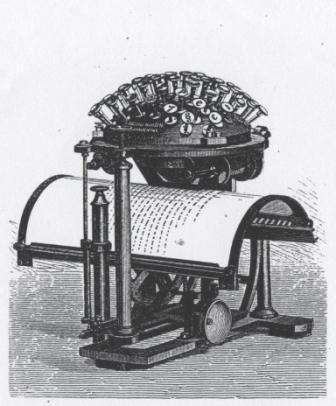
The poem in English translation:
“THE WRITING BALL IS A THING LIKE ME: MADE OF IRON
YET EASILY TWISTED ON JOURNEYS.
PATIENCE AND TACT ARE REQUIRED IN ABUNDANCE
AS WELL AS FINE FINGERS TO USE US."
(Friedrich Nietzsche, on February 16th 1882)
|
 |
| "Nietzsche Typescript, written on his writing ball: A Letter to Koeselitz, written 17.01.1882. Copyright: The Goethe and Schiller Archive, Weimar, Germany" http://malling-hansen.org |


David Strauss, the Confessor and Writer: "Culture is, above all, unity of artistic style in all the expressions
of the life of a people. Much knowledge and learning is neither
an essential means to culture nor a sign of it, and if needs be can get along very well with the opposite of culture, barbarism, which
is lack of style or a chaotic jumble of all styles." N, Untimely Meditations: 4-5
--
 |
"Fragmentary draft in Nietzsche's hand as model for a later burnt manuscript for printing of The Gay Science prepared by a writer in Naumburg. The fragment contains only the title page, second title page, and the Prelude." D-16,3. Klassik Stiftung Weimar, Goethe- und Schiller-Archiv, 2003. Manuscripts for printing, Manuscripts, DFGA, nietzschesource.org |
4. Dialogue --
A. Was I ill? Have I recovered?
Has my doctor been discovered?
How have I forgotten all?
B. Now I know you have recovered:
Healthy is who can't recall.
A. Was I ill? Have I recovered?
Has my doctor been discovered?
How have I forgotten all?
B. Now I know you have recovered:
Healthy is who can't recall.
59
Die Feder kritzelt
[31] Die Feder kritzelt: Hölle das!
The quill, it scribbles: This is hell!
Bin ich verdammt zum Kritzeln-Müssen? –
Have I been damned to have to scribble? -
So greif ich kühn zum Tintenfaß
I grasp the inkwell daringly
Und schreib mit dicken Tintenflüssen.
And write with fat ink-streams.
Wie läuft das hin, so voll, so breit!
How well it flows, so full, so wide!
Wie glückt mir alles, wie ichs treibe!
How I succeed, how I thrust!
Zwar fehlt der Schrift die Deutlichkeit –
It's true the writing lacks clarity -
Was tuts? Wer liest denn, was ich schreibe?
So what? Who reads what I write?
Attempt At Criticizing the "Attempt At Self-Criticism"
Writing sixteen years after the publication of Birth of Tragedy, it is unclear why Nietzsche employs the term "attempt" to criticize his youthful style. He is relentless in his criticism, calling BT "an impossible book -- badly written, clumsy and embarrassing, its images frenzied and confused, sentimental, in some places saccharine-sweet to the point of effeminacy." But he also calls it "a book which, as its impact has shown and continues to show, has a strange knack of seeking out its fellow-revellers and enticing them on to new secret paths and dancing-places. [...] This was the voice -- they said suspiciously -- of something like a mystical and almost maenadic soul, stammering laboriously and at random in foreign tongue, almost unsure whether it wished to communicate or conceal." Almost lamenting this faux pas, this crucial step he overlooked, he exclaims that "it should have been singing, this new soul, not speaking! What a shame that I dared not say what I had to say then as a poet: I might have been able to do it! Or at least as a philologist: -- even today almost everything in this field still remains undiscovered and unexcavated by philologists!"
Where exclamation seems to be the right expression to describe much of what is going on in his "Attempt at Self-Criticism", declamation is perhaps the accurate term that would more broadly describe this later style. The attempt is an interior monologue that resembles more closely the soliloquies of Hamlet (or Iago), than an analytic philosopher's. It is as though the text is meant to be read out loud, like Genealogy, even gesturally, for the point to be made. This undoubtedly recalls his familiarity with theories of Latin rhetoric on ELOCUTIO (style - I owe this to Bégot). Rather than simply writing, Nietzsche seems to be speaking to his text, blowing into it, through style; the spirit that would make it come to life.
Die stillsten Worte sind es, welche den Sturm bringen. Gedanken, die mit Taubenfüßen kommen, lenken die Welt.
It is the stillest words that bring on the storm. Thoughts that come with doves' footsteps direct the world.
Nietzsche himself is on a stage. In seven parts written at Sils-Maria, August 1886.
Zitatfabrik
No herdsman, and one herd! Everyone wants the same; everyone is equal: whoever thinks otherwise goes voluntarily into the madhouse.
...'No shepherd [Hirte], and one herd! Everyone wants the same; everyone is equal: whoever thinks otherwise goes voluntarily into the asylum [Irrenhaus].
... the formation of a herd is a significant victory and advance in the struggle against depression.
Verily, also new stars did I make them see, along with new nights; and over clouds and day and night I stretched out laughter, like a gay-coloured canopy.
I taught them all my poetization [Dichten: poetizing, poetry] and aspiration [Trachten: striving, desire] to compose and collect into unity what is fragment in man, and riddle and fearful chance.
As composer [Dichter: poet, lit. dictator], riddle-reader and redeemer of chance did I teach them to create the future, and all that has been -- to redeem by creating.
What do we have in common with the rosebud, which trembles because a drop of dew lies on it?
You are no stone, but already you have become hollow by the numerous drops. You will yet break and burst by the numerous drops.
It is the stillest words that bring on the storm. Thoughts that come with doves' footsteps direct the world.
O my brethren, is not everything at present in flux?
Once again did one distrust all soothsayers and astrologers; and therefore did one believe, "Everything is freedom: you can, for you will!" O my brethren, concerning the stars and the future there has hitherto been only illusion, and not knowledge; ...
"If something is to stay in the memory it must be burned in: only that which never ceases to hurt stays in the memory" -- this is a main clause of the oldest (unhappily also the most enduring) psychology on earth.
... all concepts in which an entire process is semiotically concentrated elude definition; only that which has no history is definable.
I have no doubt for what sole purpose modern books (if they last, which we fortunately have little reason to fear, and if there will one day be a posterity with a more severe, harder, healthier taste) -- for what purpose everything modern will serve this posterity: as an emetic -- and that on account of its moral mawkishness and falseness, its innermost feminism that likes to call itself "idealism" and at any rate believes it is idealism.
Vom Barockstile
Vom Barockstile. – Wer sich als Denker und Schriftsteller zur Dialektik und
Auseinanderfaltung der Gedanken nicht geboren oder erzogen weiß, wird
unwillkürlich nach dem Rhetorischen und
Dramatischen greifen: denn zuletzt kommt es ihm darauf an, sich verständlich zu machen und dadurch
Gewalt zu gewinnen, gleichgültig ob er das Gefühl auf ebenem Pfade zu sich zu
sich leitet oder unversehens überfällt – als Hirt oder als Räuber. Dies gilt
auch in en bildenden wie musischen Künsten; wo das Gefühl mangelnder Dialektik
oder des Ungenügens in Ausdruck und Erzählung, zusammen mit einem überreichen,
drängen den Formentriebe, jene Gattung des Stiles zutage fördert, welche man Barockstil nennt. – Nur die Slechtunterrichteten
und Anmaßenden werden übrigens bei diesem Wort sogleich eine abschätzige
Empfindung haben. Der Barockstil entsteht jedesmal bein Abblühen jeder großen
Kunst, wenn die Anforderungen in der Kunst des klassichen Ausdrucks allzu groß
geworden sind, als ein Natur-Ereignis, dem man wohl mit Schwermut – weil es der
Nacht voranläuft – zusehen wird, aber zugleich mit Bewunderung für die ihm
eigentümliche Ersatzkünste des Ausdrucks und der Erzählung. Dahin gehört schon
die Wahl von Stoffen und Vorwürfen höchster dramatischer Spannung, bei denen
auch ohne Kunst das Herz zittert, weil Himmel und Hölle der Empfindung allzu
nah sind: dann die Beredsamkeit der starken Affekte und Gebärden, des
Häßlich-Erhabenen, der großen Massen, überhaupt der Quantität an sich – wie
dies sich schon bei Michelangelo, dem Vater oder Großvater der italienischen
Barockkünstler ankündigt –: die Dämmerungs-, Verklärungs- oder
Feuerbrunstlichter auf so starkgebildeten Formen: dazu fortwährend neue
Wagnisse in Mitteln und Absichten, vom Künstler für die Künstler kräftig
unterstrichen, während der Laie wähnen muß, das beständige unfreiwillige
Überströmen aller Füllhörner einer ursprünglichen Natur-Kunst zu sehen: diese
Eigenschaften alle, in denen jener Stil seine Größe hat, sind in den früheren,
vorklassischen und klassischen Epochen einer Kunstart nicht möglich, nicht
erlaubt: solche Köstlichkeiten hängen lange als verbotene Früchte am Baume. –
Gerade jetzt, wo die Musik in diese
letzte Epoche übergeht, kann man das Phänomen des Barockstils in einer
besondern Pracht kennenlernen und vieles durch Vergleichung daraus für frühere
Zeiten lernen: den es hat von den griechischen Zeiten ab schon oftmals einen
Barockstils gegeben, in der Poesie, Beredsamkeit, im Posastile, in der Skulptur
ebensowohl als bekanntermaßen in der Architektur – und jedesmal hat dieser
Stil, ob es ihm gleich am höchsten Adel, an dem einer unschuldigen, unbewußten,
sieghaften Vollkommenheit gebricht, auch vielen von den Besten und Ernstesten
seiner Zeit wohlgetan: – weshalb es, wie gesagt, anmaßend ist, ohne weiteres
ihn abschätzig zu beurteilen; so sehr sich jeder glücklich preisen dargf,
dessen Empfindung durch ihn nicht für den reineren und größeren Stil
unempfänglich gemacht wird.
Wölfflin's "Magical Style of Dual Projection"
 |
| "Vergrößungs- und Projektionsapparat" |
Wölfflin also innovated ways of looking through his use of the slide projector:
“Also, slide projection, which by 1900 had become standard in academic art history, was not only used as a didactic instrument but as an autopoetic guide to research. For Grimm the multiplying projection had the same analytic approach as the microscope. He valued the slide projection over the naked eye for its higher standard of representation of the artist’s originality. How much Grimm relied on slides to construct art history as Bildwissenschaft can be demonstrated by the fact that he hardly cared for books. When Heinrich Wölfflin succeeded Grimm as the chair of art history in Berlin in 1901, he found 1300 publications, but 15,000 slides.
“Using these slides, Wölfflin was able to demonstrate and at the same time reflect upon his bipolar Kunstgeschlichtliche Grundbegriffe through his magical style of double projections. By developing his categories from examples of high art, Wölfflin meant them to be helpful in understanding the visual culture of whole epochs in the broadest sense. He never used the term Bildgeschichte, but he did call art history “the development of modern seeing,” which is in fact a broader and deeper concept.” (1)
1. Horst Bredekamp. “Art History as Bildwissenschaft.” Critical Inquiry 23 no. 3 (2003): 421-422.
151. An Jakob Burckhardt
Sils-Maria, Herbst 1888.
Esteemed Professor,
Herewith I take the liberty to present you with a small aesthetic text, which, however much amidst of the seriousness of my duties is meant as recreation, still has your seriousness to it. You will not for a moment be misled by the light and ironic tone. Perhaps I have a right to clearly discuss this "Wagner case,"- perhaps even a duty. The movement is now in the highest glory. Three quarters of all musicians are entirely or half-convinced that from St. Petersburg to Paris, Bologna and Montevideo all theatres live of this art, recently the young German kaiser has referred to the whole matter as national language of the first order and placed himself at its head: reason enough, that it is allowed to step on the battlefield. I acknowledge that the text should have been written not in German but French, through the european-international character of the problem. Up to a certain extent it is written in French: and in any case it may be easier to translate it in French rather than in German.
With the expression of great love and esteem,
Your
Dr. Friedrich Nietzsche
(My address is until mid-November Torino poste restante: a single word from you would make me happy.)
Hochverehrter Herr Professor,
hiermit nehme ich mir die Freiheit, Ihnen eine kleine ästhetische Schrift vorzulegen, die, wie sehr auch immer mitten im Ernst meiner Aufgaben als Erholung gemeint, doch ihren Ernst für sich hat. Sie werden sich hierüber nicht einen Augenblick durch den leichten und ironischen Ton irreführen lassen. Vielleicht habe ich ein Recht, von diesem "Fall Wagner" einmal deutlich zu reden, - vielleicht selbst eine Pflicht. Die Bewegung ist jetzt in höchster Glorie. Drei Viertel aller Musiker ist ganz oder halb überzeugt, von St. Petersburg bis Paris, Bologna und Montevideo leben die Theater von dieser Kunst, jüngst hat noch der junge deutsche Kaiser die ganze Angelegenheit als nationale Sprache ersten Ranges bezeichnet und sich an deren Spitze gestellt: Gründe genug, daß es erlaubt ist, auf den Kampfplatz zu treten. - Ich bekenne, daß die Schrift, bei dem durchaus europäisch-internationalen Charakter des Problems, nicht deutsch, sondern französisch hätte geschrieben werden müssen. Bis zu einem gewissen Grade ist sie französisch geschrieben: und jedenfalls möchte es leichter sein, sie ins Französische zu übersetzen als in Deutsche...
- Es ist mir nicht verborgen geblieben, daß er vor nicht lange einen Tag gab, wo die Pietät einer ganzen Stadt sich mit tiefer Dankbarkeit ihres ersten Erziehers und Wohltäters erinnerte. Ich habe mir, in aller Bescheidenheit, erlaubt, mein eigenes Gefühl zu dem einer ganzen Stadt hinzulegen.
Mit dem Ausdruck großer Liebe und Verehrung
Ihr
Dr. Friedrich Nietzsche
(Meine Adresse ist bis Mitte November Torino poste restante: ein einziges Wort von Ihnen würe mich glücklich machen.)
Sils-Maria, Fall 1888.
Herewith I take the liberty to present you with a small aesthetic text, which, however much amidst of the seriousness of my duties is meant as recreation, still has your seriousness to it. You will not for a moment be misled by the light and ironic tone. Perhaps I have a right to clearly discuss this "Wagner case,"- perhaps even a duty. The movement is now in the highest glory. Three quarters of all musicians are entirely or half-convinced that from St. Petersburg to Paris, Bologna and Montevideo all theatres live of this art, recently the young German kaiser has referred to the whole matter as national language of the first order and placed himself at its head: reason enough, that it is allowed to step on the battlefield. I acknowledge that the text should have been written not in German but French, through the european-international character of the problem. Up to a certain extent it is written in French: and in any case it may be easier to translate it in French rather than in German.
- It has not escaped me, that he gave not long ago, where the pity of the whole city remembered with gratitude her first educator and benefactor. I have, in all modesty, allowed myself to put down my feelings about an entire city.
Your
Dr. Friedrich Nietzsche
(My address is until mid-November Torino poste restante: a single word from you would make me happy.)
Nietzsche, Burckhardt, Wölfflin
Two important figures when discussing Nietzsche and style:
Jacob Burckhardt (1818-97) was Friedrich Nietzsche's colleague at the University of Basel and Heinrich Wölfflin's professor. It is known Burckhardt and Nietzsche were fond of each other's company and maintained a correspondence for years. He published The Civilization of the Renaissance in 1860, a year after Darwin's publication of On The Origin of Species. Among his students, Heinrich Wölfflin.
Heinrich Wölfflin (1864-1945). In 1893 Wölfflin succeeded Burckhardt as professor of Art History. He left Basel to succede Hermann Grimm as the chair of art history in Berlin in 1901. In 1888 he wrote Renaissance and Baroque. It has been said that the Nietzschean opposition between Apollonian and Dionysian would have influenced Wölfflin in his canonization of the principles on style. His Formalism was apparently also influenced by developing theories in the psychology of perception and Empathy, particularly with the influence of psychologist/philosopher Theodor Lipp, with whom he studied.


Subscribe to:
Posts (Atom)